8 Techniques for a Great Story

To write a great story, there are areas where you should focus on to make your story memorable. I’ve come up with eight examples of techniques that can help you get started. You can focus on one or two, or multiple techniques, depending on your writing skill level. The simplest way is to pick a situation to put your character in and then take a technique and work your character into it.

  1. Compelling Characters: Create characters with depth and complexity, each with their own motivations, flaws, and desires. Readers should be able to empathize with them and become invested in their journey.
  • Engaging Plot: Develop a well-paced and intriguing plot that keeps readers hooked from beginning to end. Include twists, turns, and moments of suspense to maintain their interest and drive the narrative forward.
  • Theme and Message: Infuse your story with a theme or message that resonates with readers on a deeper level. Whether it’s about love, redemption, or the human condition, a well-developed theme adds depth and meaning to your story.
  • Dialogue: Write authentic dialogue that reveals character traits, advances the plot, and enhances the overall storytelling experience. Each character should have a distinct voice, and conversations should feel natural and dynamic.
  • Conflict and Tension: Introduce conflict early on and escalate it throughout the story to keep readers engaged. Whether it’s internal struggles, interpersonal conflicts, or external challenges, tension drives the plot forward and keeps readers invested in the outcome.
  • Vivid Description: Use descriptive language to paint vivid images in the reader’s mind, bringing the setting to life and immersing them in the story’s world. Show, don’t tell, by using sensory details to evoke emotions and create a sensory experience for the reader.
  • Foreshadowing and Symbolism: Incorporate foreshadowing and symbolism to add layers of meaning to your story and create a sense of anticipation in readers. Plant clues and hints early on that pay off later in the narrative, and use symbols to reinforce themes and motifs.
  • Satisfying Resolution: Provide a satisfying resolution that ties up loose ends and provides closure for the reader. Whether it’s a happy ending, a bittersweet conclusion, or a cliffhanger that sets up a sequel, the resolution should leave readers feeling fulfilled and satisfied with the journey they’ve taken.

Let me know if you try any or all of these. I’d be thrilled to read what you’ve written.

(Image purchased from Depositphotos and edited in Photoshop.)

10 Creative Prompts to Get You Writing

Let’s have some fun and write stories with these prompts. Pick one, or two, or all of them, and just write. Feel free to share them with me. Just contact me here and I’ll share your stories, if you want.

  1. Museum Mystery:
    • Start or end your story with a character who gets trapped inside a museum overnight. What secrets lie hidden among the artifacts? Is there a ghostly curator guiding them?
  2. Art Heist Romance:
    • Write about an art thief who is struggling to commit the perfect heist. Along the way, they encounter a fellow art enthusiast—someone who might just steal their heart instead.
  3. Living Paintings:
    • Imagine a gallery where paintings come alive at night. What adventures await the characters as they step into these enchanted canvases?
  4. Betrayal and Betrayed:
    • Begin your story with an unexpected betrayal. How does the betrayed character seek revenge or redemption? What secrets unravel in the aftermath?
  5. Lighthouse in the Storm:
    • Set your story in a lighthouse surrounded by powerful gale-force winds. Who tends the light, and what storms—both literal and metaphorical—do they face?
  6. Whispers on the Wind:
    • Craft a tale where a crumpled piece of paper, carrying an unexpected message, is carried by the wind. Where did it come from, and where is it going?
  7. Magical Artistry:
    • Write about an artist whose work has magical properties. Can their paintings heal, transport, or reveal hidden truths?
  8. Endless Road:
    • Your character embarks on a journey down a road that has no end. What awaits them at the horizon? Is it a physical or metaphorical path?
  9. Dissolving Reality:
    • The laws of time and space begin to dissolve. How does this affect your characters’ lives? Are they slipping between dimensions?
  10. Sentient Household Item:
    • A regular household item becomes sentient. What does it experience? Does it have desires, fears, or memories?

12 Writing Motivations

If you want to be a writer but don’t know where to start, here are 12 motivations to get you going:

1. Creative Expression: Writing allows you to express your creativity and imagination. It’s a medium for crafting stories, poems, or essays that reflect your unique perspective on the world.

2. Self-Discovery: Writing can be a journey of self-discovery. Through introspection and exploration of your thoughts and emotions, you can gain a deeper understanding of yourself.

3. Communication: Writing is a powerful tool for communicating ideas, stories, and information to a wide audience. It enables you to share your thoughts and knowledge with others.

4. Influence and Impact: Writers have the potential to influence and inspire people. Your words can motivate, educate, entertain, and even change lives.

5. Catharsis: Writing can be therapeutic. It allows you to release pent-up emotions, heal from past traumas, and find solace in putting your thoughts on paper.

6. Storytelling: If you have a passion for storytelling, being a writer lets you create intricate worlds, complex characters, and compelling narratives that captivate readers.

7. Legacy: Writing offers the opportunity to leave a lasting legacy. Your written works can outlive you and continue to inspire future generations.

8. Advocacy: Writers often use their platform to advocate for social, environmental, or political causes. Your words can raise awareness and drive positive change.

9. Intellectual Growth: Writing requires research and learning, which can lead to personal intellectual growth. It encourages you to expand your knowledge and perspective.

10. Financial Potential: While not guaranteed, successful writers can earn a living from their craft through book sales, freelance work, blogging, or content creation.

11. Flexibility: Writing offers flexibility in terms of where and when you work. Many writers enjoy the freedom to set their own schedules and work from anywhere.

12. Connection with Readers: Building a connection with readers who resonate with your words can be a deeply fulfilling aspect of being a writer. It allows you to touch people’s lives in meaningful ways.

Ultimately, the reasons to become a writer are as diverse as the individuals who pursue this path. Whether it’s a lifelong passion, a means of self-expression, or a way to make a difference in the world, writing can be a rewarding and fulfilling endeavor.

TEDx and What I learned

Last Thursday, I went to a TEDx event at MSU Denver. The theme was, “Reimagining Possibilities.” It was about new ideas and going above and beyond what’s familiar.

There were a lot of good topics and a lot of things to digest and think deep on. A few of the speakers brought up “imposter syndrome,” and that really made me think. I’ve hardly spent time thinking about those words and never really thought of myself as having imposter syndrome, but somehow the speakers got me thinking. Yes, I am guilty of this imposter syndrome. I do feel out of place sometimes and I do wonder if being a writer/author/entrepreneur is the right path for me. Not because I don’t think I’m qualified, but because the recognition isn’t there, and not by others, but by my own thoughts.

In the Business Harvard Review (2008), in the article, Overcoming Imposter Syndrome, Gill Corkindale says:

Imposter syndrome can be defined as a collection of feelings of inadequacy that persist despite evident success. ‘Imposters’ suffer from chronic self-doubt and a sense of intellectual fraudulence that override any feelings of success or external proof of their competence. They seem unable to internalize their accomplishments, however successful they are in their field. High achieving, highly successful people often suffer, so imposter syndrome doesn’t equate with low self-esteem or a lack of self-confidence. In fact, some researchers have linked it with perfectionism, especially in women and among academics.

I have to admit, I’ve had imposter syndrome before with other endeavors I attempted. This path is no different. However, I’m older and I’d like to think I’m a little wiser and just maybe the choices I’m making now are choices I’m going to stick with. I have more time on my hands and that means more time to really think things through.

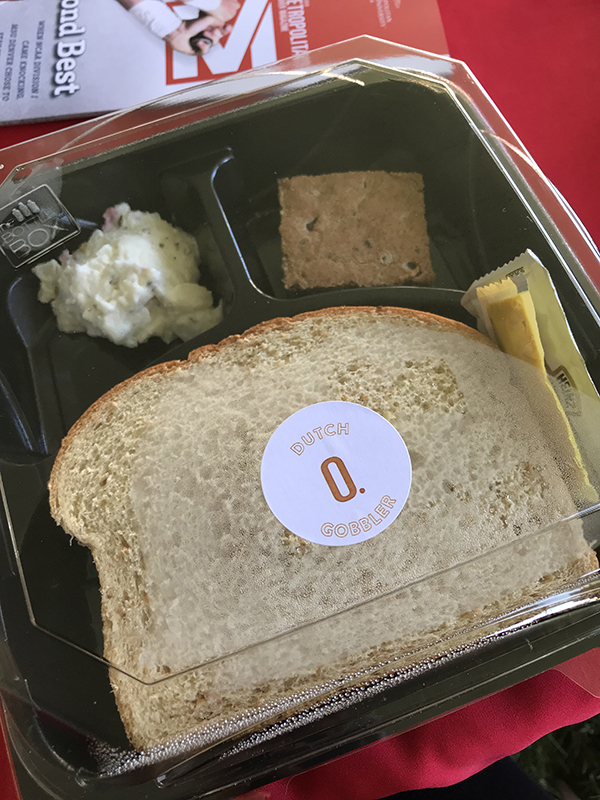
Back to the event. It was split into three one-hour sessions. After the first session, they served us lunch. It was nicely set up under a large tent on the lawn north of the building where the talk took place.

They served three or four different types of sandwiches and drinks (water, tea, lemonade). I had the Dutch Gobbler which was basically a turkey sandwich. I met a family whose grandmother said her daughter was a speaker and would be the first speaker after lunch. She was backstage rehearsing so she wasn’t able to have lunch with everyone.

After the second session, I left. I wanted to stay for the full event but I had other business to tend to. This was my first TEDx event and I’m happy to say, the experience was worth it.